Recently, our group significantly enhanced the xylose growth ability of the yeast Komagataella phaffii.
Xylose is the second most abundant monosaccharide in lignocellulose, and efficient xylose catabolism is a desirable phenotype for cell factories to synthesize value-added products from biomass. K. phaffii (also known as Pichia pastoris) is a widely used chassis for the production of heterologous proteins and chemicals. However, K. phaffii cannot efficiently utilize xylose as the sole carbon source, which has markedly hindered the valorization of lignocellulosic biomass.
Our team combined metabolic engineering, adaptive laboratory evolution (ALE), multi-omics analysis and reverse metabolic engineering to increase cell growth on xylose in K. phaffii. The engineered strain exhibited the highest reported specific growth rate μmax of up to 0.042 h−1 and shortest lag time of 25.0 h from sole xylose in minimal media. This strain also showed efficient production of free fatty acids and partial alleviation of glucose repression from xylose.
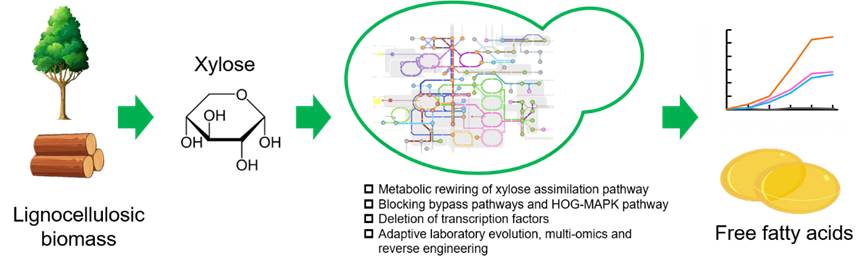
This study was published in Metabolic Engineering. This work was supported by the National Natural Science Foundation of China. (Text and image by Kun Zhang).
Link:https://doi.org/10.1016/j.ymben.2026.02.001
中文版
